Discovering not only what was written for the great lost libraries of history, but what was written ON has been fascinating. My talk on the subject begins with the rise of civilisation in the lands of Mesopotamia where the river beds of clay provided an early material for recording statistics and stories. It moves to the use of Egyptian papyrus in the production of scrolls, which spread around the Mediterranean. This lucrative export became in the 2nd century BC the source of a trade war between the corners of Alexander the Great’s former empire. The kingdom of Pergamum in Asia Minor not only had wealth, but also a library that rivalled Alexandria’s. One way the Egyptians knew that would hit the intellectual aspirations of this competitor (which was also poaching some top philosophers) was to cut off the supply of papyrus. However King Eumenes of Pergamum simply switched to the use of animal skins. This new (non-vegan) “parchment” was not new, but Eumenes and his heirs became so adept at its manufacture the Romans were soon calling it “Pergamena”. Papyrus scrolls continued to be used for centuries but more hard-wearing parchment would eventually replace it for archives and important documents.
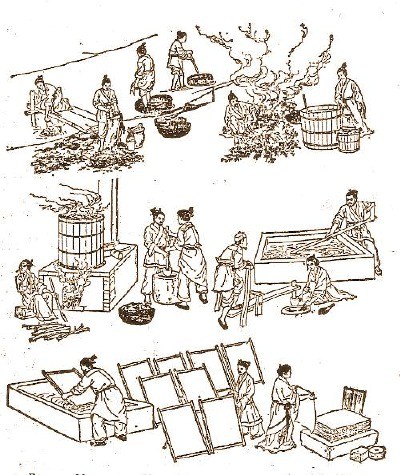
At roughly this time, however, around the world from Mexico to China, people were already experimenting with the use of mashed tree bark and wooden fibres to make pages for books. The Chinese had previously used expensive bamboo and silk, but by the second century AD were making something close to our modern idea of paper. The first recorded use was in Lei-Yang by Ts’ai Lun, a Chinese court official. Ts’ai mixed mulberry bark, hemp and rags with water, mashed it into pulp, pressed out the liquid, and hung the thin mat to dry in the sun. By 645 AD this technique had been perfected and had spread to Tibet, Korea and India. Then in 751 AD there was one of those epoch-defining moments in history, a true clash of empires. The Abbasid Caliphate defeated the army of the Chinese Tang Dynasty at the Battle of Talas River, in modern Kazakhstan, stopping China’s western expansion in its tracks. Their prisoners of war would reveal the secrets of paper-making to the Arabs, eventually leading to a paper industry centred on the Abbasid capital, Baghdad, and helping fuel an Arabic revolution in literacy and learning. Books could now be made, copied and sold far more easily than before. Libraries and universities sprang up throughout the growing Islamic world (as far as Timbuktu in West Africa) as did paper mills. The first established in mainland Europe would be in Cordoba in Spain under the Umayyads around 900 AD, with a book-selling industry and libraries to match.
Christian Europe took a while to catch on to the potential of paper. Paper-making was common in Italy by the 12th century but only arrived in England around the same time as the first printing presses. The first reference to a paper-mill here was in a book printed by Wynken de Worde in 1495, belonging to one John Tate living near Hertford.

