Silent cinema was never actually silent. You’ll probably know from your parents or grandparents that a large organ might rise up in front of the screen of the local cinema, not in a rude way, and entertain the audience between shows. This is a throwback to when movie houses used to employ thousands of musicians across the world, playing along to the flickers with stock tunes, jazzy improvisations and sound effects to accentuate the mood or action. These musicians would find themselves suddenly unemployed with the establishment of films with synchronised sound between 1927 and 1930. The comedian Harold Lloyd recalls in his youth around 1910 going to watch a movie that had live actors literally improvising the dialogue from behind the screen, but efforts to bring sound to the moving picture go back even further than that. To the very birth of cinema.
As part of my research into my latest talk “Speak Easily? When Hollywood’s Clowns Learned to Talk” I’ve uncovered the bizarre and surprising history of the noisy silents, full of many echoes in the way we access film and video today. As you’ll hear Thomas Edison, one of the forefathers of both recorded sound and moving pictures dabbled for years in this pursuit. His revolutionary vision was of personalised entertainment, not a communal one.
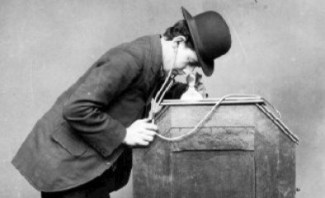
The Kinetoscope saw individual patrons looking at a peepshow with short films of just a few minutes long and in 1895 he introduced recorded sound to these devices, with headphones, dubbing it the Kinetophone (above). It never took off, he would only sell 45 machines, and soon spectators turned to the more comfortable and sociable experience of watching films in a cinema, but in today’s world of watching funny YouTube clips on your smartphone, cut off from the stress of your commute, maybe he was onto something.
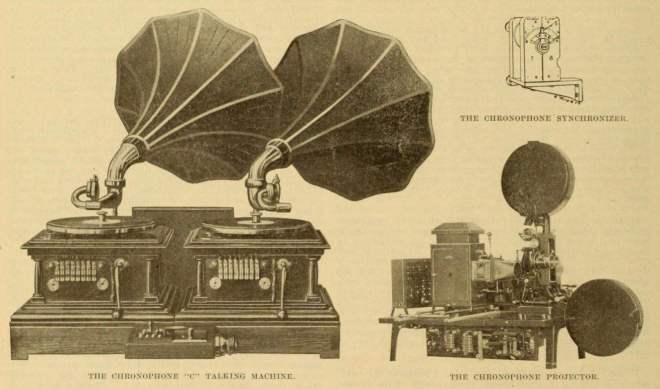
The phonograph record would provide the next leap forward and for the first 13 years of the twentieth-century the French would lead the way in adding music and voices to the shadows on the screen. It became a common experience to have short interludes in the programme with musical and theatre stars filmed (sometimes in colour) recreating their latest stage success, very much like a modern pop video. The sound of the voice and music amplified by compressed air thanks to the twin turntable Chronophone, arguably the world’s first proper loudspeaker. To maintain longer sound accompaniment the operator could switch seamlessly from disc to disc like a modern DJ, but the effort to keep this synchronised with what was going on on the screen, must have been immense. It was a bit of a cheat though as all these sounds were recorded before into the record player’s horn with the performer standing right next to it. When it came to film the performance they’d be miming to what they’d originally recorded so actually the audience would hear the same disc the singer had. The First World War and the lack of any real enthusiasm for these static, scratchy, slightly out of synch experiences doomed this technology. The “silent” cinema would rise and prosper, with its fluid camerawork unencumbered by trying to both capture sound and vision, and live musical accompaniment, for the next decade. It would suit a whole generation of miming clowns from across the globe, from Americans like Fatty Arbuckle, Mabel Normand and Buster Keaton, the Australian Snub Pollard and the British Charlie Chaplin and Stan Laurel, who developed a brand new art form that made millions laugh.
But the dream of synchronised, recorded sound, either played back on an accompanying disc or recorded onto the film itself would not die. As soon as recording and amplification techniques were perfected in the mid 1920s it was only a matter of time before somebody made the movies properly talk. The only question was, would the public actually want them to?


Reblogged this on Brent Libraries Blog and commented:
Can’t wait for this talk on Wednesday!
LikeLiked by 1 person