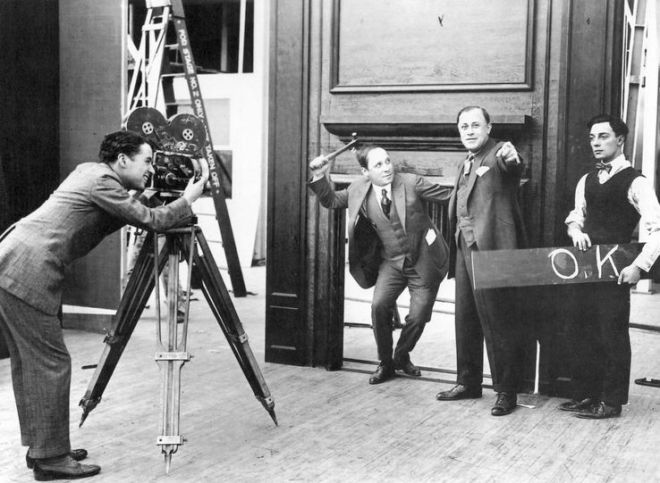
At both my recent talks I’ve been approached by curious audience members in their 20s and 30s coming up to me and asking which movies they should watch now I’ve made them aware of the brilliance of silent comedy. These wonderful films no longer appear on TV and only sporadically pop up on the big screen at lovely venues like the BFI Southbank, Regent Street Cinema and the Cinema Museum so DVDs, Blu-Rays and Youtube are the only realistic options, especially if you’re not based in London. Luckily around a decade ago film companies started issuing excellent box sets of the work of Buster Keaton, Harold Lloyd, Laurel and Hardy and Charlie Chaplin (other suppliers are of course available). Youtube meanwhile is an extraordinary resource, albeit a little hit and miss when it comes to musical accompaniment and picture quality, and I’ve found hours of Harry Langdon and early Stan Laurel material. There’s also a peculiar, yet engrossing cartoon from 1929 explaining the new talkie technology called “Finding His Voice”.
Missing from the Keaton set are his first two (excellent) silent comedies for MGM – “The Cameraman” and “Spite Marriage” – and his (dreadful) talking pictures. Luckily all his other solo films up to 1928 are represented, including the Civil War epic “The General” (1926), with a superb orchestral score by Carl Davis. Perhaps it’s not as funny as his earlier work like “Sherlock Junior”, but it pushed film-making technology to new heights of spectacle. Of Lloyd’s work, two films stand out for me: his ultimate “thrill-picture” “Safety Last” (1923) and his final silent “Speedy” (1928) – shot almost entirely on location in New York City. The DVD/Blu Ray of which has a ton of brilliant extra material. Ironically Chaplin’s towering achievement as a film-maker – “City Lights” (1931) came after the rise of the talkies, when he’d had time to watch his contemporaries succeed or fail with the new technology. He cleverly harnessed synchronised sound and music without compromising on his strengths as a performer and director of mime. For an introduction to Chaplin the director check out Kevin Brownlow and David Gill’s superb documentary “Unknown Chaplin” (who also made similar series about Keaton and Lloyd, available on Youtube.) I’d also recommend a very jolly compilation movie made by film historian Robert Youngston in the late 1950s “When Comedy Was King”. Youngston was not only instrumental in re-introducing movie-goers to the silent greats, both notorious (Fatty Arbuckle) and largely forgotten (Anita Garvin, Charley Chase) but in editing this film (and its sequels) saved much original film-stock from destruction.
All the silent clowns started their career making short two-reel comedies (a reel lasts around 10 minutes) which are brilliant for kids. Chaplin’s best early films were for the Mutual Film Company between 1916 and 1917 and display how fast he’d picked up the ability to tell moving, thrilling, funny stories that have stood the test of time. The broad vaudeville performances, the make-up and the depiction of extreme poverty in many of these films is occasionally jarring, but happily contain plenty of people being kicked up the backside.

