I’m touring London’s libraries this month to present a new illustrated talk inspired by Cityread’s choice for 2018: “The Muse” by Jessie Burton, bestselling author of “The Miniaturist”. It’s an entertaining historical mystery that straddles two eras: London in 1967 and Spain on the eve of civil war in 1936. As art history is the major theme of the story I decided to take a look at some of the art that grew from the harrowing conflict that ensued. It’s proved to be a huge challenge!
Clearly the most famous single work to come out of the era was inspired by an actual atrocity, the bombing of an unprotected market town: Pablo Picasso’s monumental “Guernica”. However, uncovering the creation of this painting has led to many more interconnected stories and works. As “Guernica” found a temporary home at the Whitechapel Art Gallery in 1939, one aspect I was keen to research was the way British artists reacted to the war. A trip to the gallery’s archives opened my eyes to the propaganda importance to the British Left of art in general and Picasso’s work in particular and for raising money for the Republican cause in Spain. The Marx Memorial Library in Farringdon provided some heartbreaking material: a banner woven by the women of Barcelona to thank the International Brigade for their fight against Franco and poignant sketches from two artists who actually fought: Felicia Browne and Clive Branson, as well as letters about and by them and newspaper cuttings. The library’s collection of propaganda posters from the era is extraordinary and worth a visit. I would also like to acknowledge the advice and material from the Pallant House Gallery, whose 2014 exhibition “Conscience and Conflict” was a big inspiration for the talk.
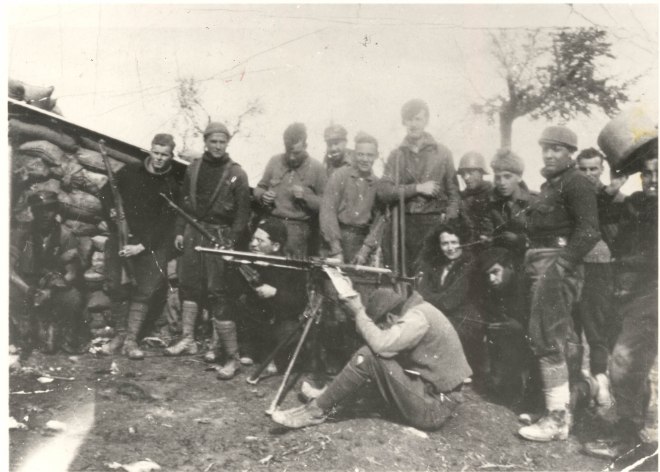
Russell Martin’s “Picasso’s War”, Simon Schama’s “The Power of Art” and TJ Clark’s “Picasso and Truth” all provide great insights into the creation of Picasso’s masterpiece. There are simply too many books on the war to list here, but those that have proved most valuable to me have included Paul Preston’s “Franco” and “The Spanish Civil War”, written from a passionately leftist perspective, they are a more engaging read than Antony Beevor’s otherwise exemplary “The Battle for Spain”. Gerald Brenan, a British ex-pat lived through the war and his sympathy for and his frustration with his adopted country shines through “The Spanish Labyrinth” which attempts to answer the question of why a civil war in Spain happened. I am still reading Richard Baxell’s brilliant and moving history of the British soldiers of the war “Unlikely Warriors” – which puts into perspective how the internal fight against fascism in this country was an issue in the 1930s too. George Orwell’s “Homage to Catalonia” (see him above as the tallest of the soldiers on the front line in 1937) is a provocative and melancholy memoir of a man losing the will to fight, whilst Ernest Hemingway’s “For Whom the Bell Tolls” is a tense and fictionalised account of the planning of a single guerrilla attack, based on people the controversial American journalist interviewed and fought beside.

