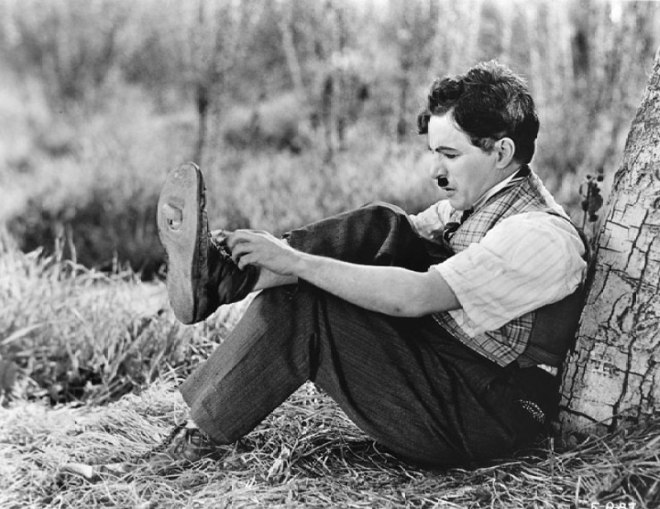
“The boys roamed the streets for diversion, Syd wearing a pair of shoes as “holey as Gruyere cheese” and a worn out jacket. Charlie wore a pair of his mother’s red stage stockings… how the other children laughed at them.” (Picturegoer Magazine, 1952)
When you research Charlie Chaplin’s (and his elder brother Sydney’s) life and work, you find an awful lot about shoes. Thanks to his diligent biographer David Robinson we know that Charlie was descended from Shadrach Chaplin, the village boot-maker of Great Finborough in Suffolk, at the time of the Napoleonic wars. His great-great-grandson a century later would become one of the few movie-stars identifiable by their choice of footwear. After “Making A Living” his very first film, with the Keystone Studios, in 1914 proved to be less than successful, Chaplin desperately needed to come up with a new funny costume. According to reports he pillaged the clothing store for an outfit of contrasts – a derby hat and jacket that would be too small, and voluminous trousers (Fatty Arbuckle’s?) and size 14 shoes (Ford Sterling’s?) far too big. The latter placed on the wrong feet to stay on and giving The Tramp (as Charlie’s new persona would soon be dubbed) a distinctive splay-footed walk. It was a costume he would continue to wear in pictures for another 22 years.
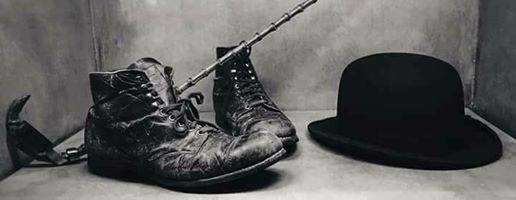
Alec Guinness (who would go onto star opposite Chaplin’s daughter Geraldine in “Doctor Zhivago”) once said that getting his shoes right was his first step in finding a performance. Chaplin’s performance from his second film on is really built on his shoes (seen above displayed at Chaplin’s World in Vevey, Switzerland), his gait and how he walks, runs and spins on one leg around corners. There were many influences on his ability to move in such a splendidly funny way. Fred Kitchen was an old trouper from the Fred Karno company who may have taught him a similar walk, and Chaplin himself spoke of a crippled tramp named Rummy Binks he used to do cruel impressions of as a child, but it is the choice of oversized shoes that makes Chaplin, Chaplin. It also helped that he was a trained dancer, in clogs.
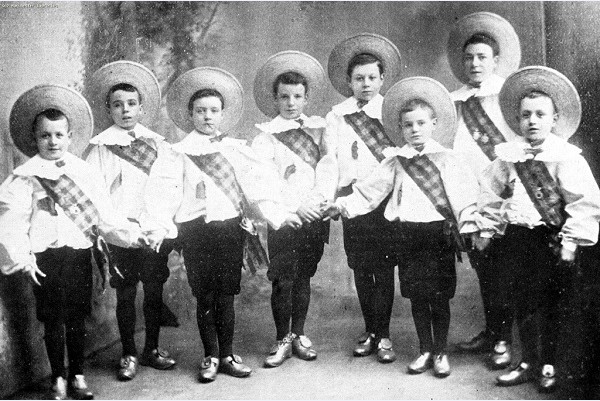
Chaplin the clog-dancer (or wallopper) is an unjustly overlooked part of his early career. It was his first professional gig, aged just nine (this may be him above dead centre of the picture), taking him away from the poverty of South London on a nationwide tour as far afield as Scotland and Dublin. It was down to the influence of his estranged father, popular entertainer Charles Chaplin Sr., who discovered a vacancy in the act called The Eight Lancashire Lads. Rather than pay the maintenance due to the family he had left he recommended his son to Mr William Jackson, the manager, who would send half a crown a week to Charlie’s mother. So, despite neither being from Lancashire, nor ever danced or sung professionally before, young Charles Junior became the new eighth lad in early 1899. He spent six weeks learning the synchronised dance steps in unfamiliar wooden-soled shoes (and the Lancashire accent), performed with his new colleagues in a pantomime and then went on the road for nearly 2 years. The act looks more like tap-dancing to modern eyes – there is a video of a later iteration of the lads from 1931 here (1.47 minutes in) – and you were expected to sing and dance solo too. And it was popular, one glowing review describes “a very fine exhibition of clog-wallopping” and in Nottingham “they danced charmingly in response to the loud demands of their admirers”. These young boys worked hard, they were almost constantly on tour for most of 1900. On some bills they would not have their ten minute slot until after 9 or even 10pm, but were mixing with some of the biggest stars in showbusiness, including comedians George Robey and Dan Leno, both of whom Chaplin’s Tramp owes much in his appearance. The ambitious Chaplin would leave the act in December of 1900, seeking opportunities as a boy actor. However the discipline, skills and confidence as a performer, to often huge audiences, that he was taught by Jackson, would last a lifetime: “It was good training” Chaplin would remark years later, “fitting us for the harder work that comes before the goddess of success began to throw her favours around”.


Reblogged this on Brent Libraries Blog and commented:
Interesting stuff! Looking forward to learning even more at the event in December.
LikeLiked by 1 person