“The more outré and grotesque an incident is the more carefully it deserves to be examined.” Sherlock Holmes
“The Hound of the Baskervilles” is the third Sherlock Holmes novel from Arthur Conan Doyle. It holds a unique place in the canon of the great detective’s cases for many reasons: it was the first Holmes story of the twentieth century, it saw Holmes return from the dead (in literary, if not narrative terms) after 8 years and finally it has been adapted more times for other media than any other Sherlock Holmes adventure. It’s still the most popular of the stories and has endured the indignity of being made into the worst movie starring Dudley Moore in history, so what is the secret to its longevity and how successfully has it translated off the printed page? Spoiler alert below…
Originally serialised in The Strand Magazine from August 1901 to April 1902, it tells the story of murder on Dartmoor inspired by the legend of a diabolical hound. Sherlock Holmes’ help is sought by Dr Mortimer, a friend of the late Sir Charles Baskerville of Devon, who died of fright, but whose body was surrounded by “the footprints of a gigantic hound”. The heir to the Baskerville fortune is due in London and Mortimer fears for his life. Holmes, surprisingly, delegates both bodyguard and detective duties to Dr Watson and is absent for much of the first half of the story. It’s a spooky assignment on the moors, but Watson diligently investigates the Baskerville family and their neighbours. Holmes finally reveals he’s been secretly on the case all along and has solved the mystery: a hitherto hidden heir, Jack Stapleton, trying to bump off the claimants to the family fortune, using the centuries-old legend of a ghostly dog. Although his trained and hungry Great Dane is all too real, and is able to be killed by Holmes.
The key to the success of the story in the Strand is that each chapter ends on a proper cliffhanger. It’s fresh and exciting. You can tell Conan Doyle enjoyed returning to writing about his detective after nearly a decade. In the meantime he’d continue to write other stories and even travelled to South Africa to work as a military doctor in the Boer War, but here was a tale, drawing on real local Devon legends, that was worthy of his greatest creation. It was very effectively illustrated by Sidney Paget and proved a smash hit for the magazine, and eventually a bestselling novel, translated into many languages. It was extremely popular in Germany and within 5 years it had been adapted for the stage by playwright Richard Oswald as “Der Hund von Baskerville”, oddly relocating the action to Scotland. Oswald would turn his very singular version of the story into a screenplay for the first film version in 1914. Alfred Neuss played a very dapper Holmes, Watson was relegated to a brief scene at the beginning and the majority of the action is a battle of wills between Stapleton (revealed to be the villain at the start of the film), his big dog and Holmes. It’s very odd, but far more entertaining than the “official ” Sherlock Holmes film starring William Gillette partly based on “A Scandal in Bohemia” and “The Final Problem” that was released soon after. “Der Hund” would begat 7 sequels as Stapleton escaped from prison to wreak his revenge.
The first genuine version of the story would be released in 1921 and starred Eille Norwood. Already the star of a series of short films closely based on Doyle’s stories this was his first feature film as the detective and featured a convincing recreation of Dartmoor around the village of Thursley in Surrey by director Maurice Elvey. In 1929 Richard Oswald returned to the story, this time as director, and helmed a strikingly beautiful movie that took fewer liberties with Doyle and starred American actor Carlyle Blackwell. The first talking picture based on the novel would appear in 1932 and featured a very unconvincing Holmes in Robert Rendel. It was described by one contemporary reviewer as “tedious”, with the Hound himself ranked as the best actor in the movie. Far better, and still standing as the best version was Basil Rathbone’s debut as the sleuth in 1939. A sumptuous period drama that only a Hollywood studio like Fox could conjure up, it contains the right combination of thrills and laughs and is probably the first time cinema truly captured Doyle’s work in all its Victorian glory.
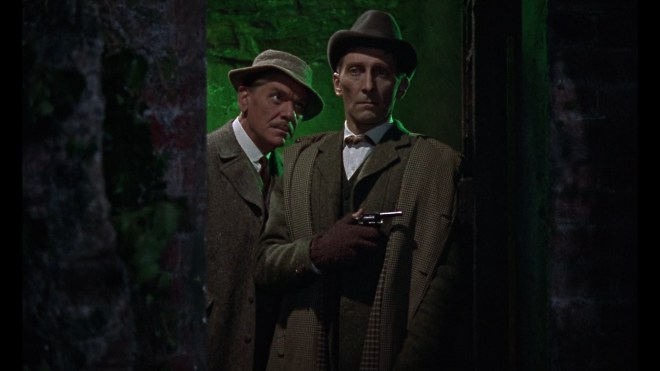
It cast a long shadow, it would be 20 years until another film version would be released. In keeping with their tradition of remaking 1930s horror, the British Hammer studios, following on from tackling Frankenstein, Dracula and the Mummy turned to the Hound for his first appearance in colour. Like most of their movies of the time it starred Peter Cushing (as a rather short, but dynamic Holmes) and Christopher Lee (as the villainous Stapleton). It’s garish and a bit hysterical but still stands up well and there’s a really good Dr Watson from Andre Morell. Cushing would return to the part and to the Hound in a BBC version 9 years later. This older Holmes got to clamber around the real Dartmoor for the first time but was hamstrung visually with some very cheap studio sets. A far more lavish 4 part BBC production followed in 1982 as part of the much-missed Sunday Classics strand, and is the only time that the complete story was lifted almost word for word onto the screen. Produced by former Dr Who boss Barry Letts he cast the recently-retired Time Lord, Tom Baker who makes a very tall and twinkly Holmes. Terence Rigby is a real let down as Watson though who appears half-asleep throughout. Hot on its heals came another Hound the following year for US TV. Ian Richardson is another diminutive, but effective Holmes, production values are superb and the supporting cast is extraordinary featuring Denholm Elliott, Brian Blessed and Martin Shaw as Sir Henry Baskerville. The film is ruined by Shaw’s inexplicable dubbing, with the Canadian aristocrat sounding like a friendly Texan cowboy. Yee-ha.
The tradition of “authentic” versions of the story continued with Granada TV’s production as part of their long-running series starring Jeremy Brett and Edward Hardwicke in 1988. Sadly budget cuts and Brett’s obvious ill-health makes this a depressing watch. It’s a pedestrian take of what now seemed to be a well-trodden path and missed the flair of first-choice director, John Madden who (perhaps wisely) was otherwise engaged. The BBC’s most recent remake was announced with much fanfare for Christmas 2002. Utterly bizarrely the casting director had secured the services of the tall, dark and charismatic star of “Withnail and I”, Richard E Grant, but instead of handing him the obvious part of Holmes, he was given Stapleton. Meanwhile bland, ginger Australian Richard Roxborough who was (checks notes) the baddie in “Moulin Rouge” (no, still can’t place him) got cast as the great detective. It was a handsome production let down by a rather rubbish CGI hound the size of a stegosaurus created by the team behind “Walking with Dinosaurs” – who seemed still stuck in the Jurassic. And why is Ian Hart’s Watson angry with Holmes all the time? Perhaps reflecting the frustration of the viewers when a better Sherlock was literally standing there in the same scene.

