The heavyweight battle of the cinematic ages, between two titans of comedy. This rather tiresome debate has been raging for decades. But in advance of my latest talk for Brent Libraries, which examines the career of Buster Keaton, I’ll just add in my penny’s worth.
Charlie Chaplin came to movies first, in early 1914. Handpicked from his stage performances by talent scouts from Mack Sennett’s Keystone Studios, his first movie “Making A Living” lacked both subtlety and the famous tramp persona that would start developing from his second film. Keaton was still in vaudeville, performing with his increasingly unreliable father at this time. He wouldn’t break up the dangerous double-act (they spent each performance beating the **** out of each other) for another 3 years. But almost immediately was offered a supporting role in a Roscoe Arbuckle comedy, where he made a big impact on set with his bravery and comic timing. From the start, Keaton’s combination of a blank expression and athletic ability was clearly a great fit for the silver screen. Arguably it took Chaplin, a much bigger stage star than Keaton had ever been, far longer to shed some of the more histrionic aspects of his performance, and to develop a more nuanced screen personality.
By the time of Keaton’s first films in 1917, Chaplin was the biggest star in Hollywood, if not the world. He’d achieved this quickly by critically observing Arbuckle and other stalwarts of the Keystone studio, and worked out that he wanted stronger stories for his own films than his employers were willing to provide for him. Within a year he was directing and soon after found more independence, first with the Essanay studios, and then with the Mutual Film corporation, who paid him more than any actor on the planet. Chaplin’s ability to concoct funny, yet romantic scenarios (that featured his then girlfriend, Edna Purviance, and a host of talented supporting players) struck a chord with audiences, making them both laugh and cry within a 20 minute short film. Keaton would get his own studio in 1920 (ironically moving into Chaplin’s Mutual lot, when he vacated to new premises), but his short subjects are very different. Unlike Chaplin, who maintained an iron grip on all aspects of production, the more easy-going Keaton employed a co-director to help oversee the look and pace of each film. The results are that his movies seem more of a visual spectacle, full of action and stunts and less focussed on close-ups and character development. Whereas Chaplin draws you into intimate moments of emotion, Keaton wants to excite and thrill on a big canvas.
Ironically it was Keaton who got to star in a feature before Chaplin. “The Saphead” (1920) is a forgettable adaptation from a Broadway farce that doesn’t hold a candle to Chaplin’s extraordinary (if melodramatic) “The Kid” that followed a year later. Both stars would spend the rest of the decade creating some of the most memorable comedies of all time. By now, both had settled on defined comic masks: Keaton’s stoic “Stoneface” American everyman that could be dropped into any situation (or period) and improvise his way over any obstacle with the mind of a genius engineer. Chaplin’s Tramp was (in Keaton’s words) simply a “bum”, usually a vagrant, but with the arrogant air of an English aristocrat fallen on hard times, who won the day through both charm and cunning. These reflected their own ways of working. Keaton seemed to find film-making an utter joy, with a close-knit team of gagmen around him and a strict timetable of two films per year with set release dates. Chaplin (who was also his own producer) had less structure around him, and could literally take as much time as he wanted over each movie, but with this freedom came many added pressures. He would agonise over casting and editing and his emotional life was a mess. After 1923, he would only release two more films that decade: “The Gold Rush” and “The Circus”, both plagued with technical issues. Keaton’s team released an impressive eight, before his ill-fated move to the MGM studios in 1928.
Comparing their work at this time is fascinating. Particularly two films from 1925, where the filmmakers appear to be drawing off each other in surprising ways. Chaplin’s “The Gold Rush” at times seems like an homage to Buster. Like Keaton’s “Our Hospitality” (1923) it is a period comedy with thrills, not just slapstick and romance, and set in the nineteenth, not twentieth century, with the tramp involved in many stunt sequences. Charlie even found snowbound locations close to where Buster filmed “The Frozen North” (1921). Keaton’s “Go West” meanwhile owes a huge debt to Chaplin, drawing on the Tramp persona and aspects of “The Pilgrim” (1923) – like this film, another spoof Western. Keaton plays a more lonely and desperate character than usual here, a vagrant named “Friendless”, who forms a charming double act with a cow. This brilliant partnership is highly reminiscent of Chaplin’s own symbiotic performance with Scraps the puppy in “A Dog’s Life” from 1918. We have to remember that Hollywood in the 20s was a small community and Keaton and Chaplin met frequently socially, so were always aware of each others work.
Chaplin strongly advised Keaton against moving to MGM. He was worried his friend would lose artistic control of his work, and was sadly proved right. While Chaplin’s own studio would produce three of the most successful and renowned movies of the 1930s: “City Lights”, “Modern Times” and “The Great Dictator”, Buster Keaton was simply a hired hand in a massive film-factory. Plagued by alcoholism and two divorces he would never direct another film. Chaplin also had two failed marriages behind him by this time, and like Buster two sons, but at least he was able to see his children. Keaton’s ex-wife, in a response to Keaton’s philandering and boozing, not only changed the boys’ surname to hers but denied all access to their father. I think it was Chaplin’s experience of seeing his father literally drink himself to death in the 1890s that warned him off alcohol in his adult years.
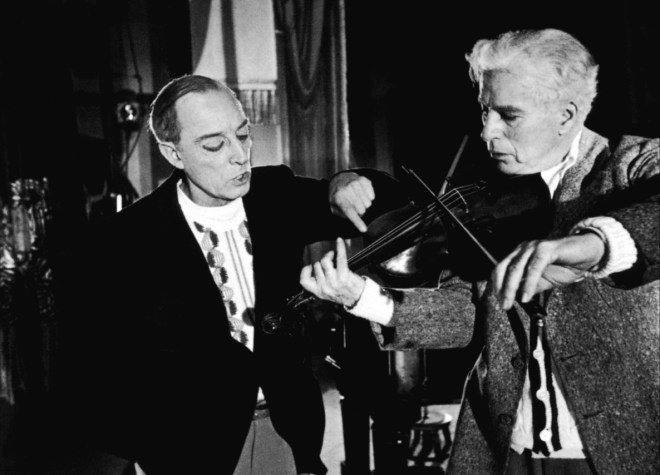
The two old troupers would finally reunite on screen in 1952 (see photo above). Chaplin’s last Hollywood picture was a music hall drama entitled “Limelight”. One of the few comic moments is a very manic, theatrical sketch without dialogue featuring Charlie and Buster as two clowns playing piano and fiddle. It’s a delight. Keaton was back in the limelight himself now, with regular guest appearances in movies, on television and on stage. His silent work was about to be rediscovered and restored by a new generation and for the last 14 years of his life he’d be busier than ever. Chaplin however would go into political exile and semi-retirement, making only two further movies (both produced in England) before he died in 1977.
Despite being similar ages and working in the same industry at the same time, often just a few miles away from each other, it is remarkable how distinctive their work turned out to be. The key for me is in a bit of amateur psychology. Keaton grew up in a nuclear family, two parents, three children, they often performed together and had a real bond. They were never hungry and always busy, simply focused on the next show. Chaplin had no such upbringing, his father left his mother early on, and then his mother went insane. There were periods of extreme poverty. The Tramp is simply the childhood Charlie grown up having never discovered showbusiness. He had to be self-reliant for much of his early life. Keaton was used to being in a team and produced his films in an open, collegiate atmosphere. Chaplin was more withdrawn, isolated, constantly trying to escape his past (or reimagine it for laughs) and improve himself. Keaton’s persona throughout the 20s is the perennial juvenile, sometimes part of a wider family, whereas Chaplin is very much an independent (if grotesque) adult.
In his introduction to a reprint of Keaton’s autobiography (ghostwritten by Charles Samuels), critic Dwight McDonald espouses that “during the Seventies Keaton replaced Chaplin as the master of movie comedy… this is the Age of Keaton.” I would argue the pendulum has since swung to a more balanced view. They are clearly BOTH masters of their art. Personally I admire Keaton’s work immensely, but I’ve always enjoyed Chaplin more. Perhaps it’s because we now live in a more uncertain and unequal world of foodbanks and pandemics that the Tramp, that flawed and hungry soul, speaks to me more than the resolute and indestructible Stoneface.


Thx for the article! I recently watched Keaton’s Sherlock Jr. and really enjoyed it. It was my first film of his. I’m gonna watch modern times now to get some chaplain in. It felt strange going from Keaton to chaplain and needed an explanation for why. I’ll be thinking about your article as I watch more. Cheers!
LikeLike