Buster Keaton was always one of the greatest innovators of screen comedy. From his very first co-directing jobs with Roscoe “Fatty” Arbuckle he constantly sought for more modern and groundbreaking ways to use a camera in search of the next big laugh.
Fans will already know about his ideas for shutting off areas of a camera’s lens in order to create unreal special effects. The greatest example of this was the short “The Playhouse” (1921). His friend and rival Chaplin had appeared in dual roles as two audience members in “A Night at the Show” (1915) but Keaton knew he could top this. Using a similar set to recreate a vaudeville theatre, Keaton not only played two roles, but ALL of them. Married couples or a mother and a son were filmed with half the lens covered to only expose one Keaton performance, then the film was rewound and then the second Keaton character was recorded. The house band was filmed in the same way with Buster playing all the instruments. Finally an entire minstrel show of nine Keatons on stage appears. It’s magical and bewildering (it is all a dream of course!) and is mainly thanks to Buster’s regular cameraman Elgin Lessley, known as “the human metronome”, hand cranking the camera to ensure everything was timed perfectly. Keaton also pioneered, through the use of brave stunts and editing, the aesthetics of the modern action-film. There are sequences in “Cops” and “Sherlock, Jr.” that would not look out of place in the “Mission: Impossible” franchise.
What is less well-known are the times Keaton pushed the technology even further. He was reluctant to make a movie of a rather tired Broadway comedy “Seven Chances” in 1925, but despite a dull, cliched script, Keaton turned out something splendidly cutting-edge. A scene filmed in early Technicolor opens the film, there are impressive uses of cross-cutting and he used the very modern idea of test-audiences to hone some of the gags – which resulted in one of his most famous climactic stunts (clue: it involves a huge number of giant rocks).
These extraordinary cinematic visions were noticed by a new school of modern art in Europe: the Surrealists. Hardly a cultured or educated man, Keaton was simply trying to make people laugh with outsized newspapers and a house with the roof attached sideways, but for the likes of Dali, Lorca and Bunuel he was a visionary and a major influence. In embracing camera trickery and the bizarre, Keaton inadvertently made the surreal mainstream.
When Keaton joined MGM in 1928 he was their only leading comedy star and expected a degree of creative independence, which sadly never transpired. One of his priorities was to make pictures with the new technology of synchronised sound. However he would have to wait two years for his first talkie. “Free and Easy” (1930) is an embarrassing musical misfire in today’s eyes, but at the time was a huge hit and Keaton was applauded for his speaking and singing role.
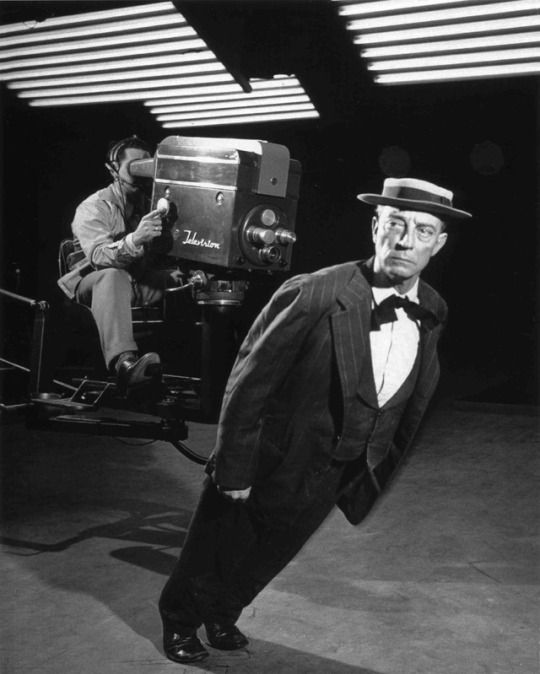
On the comeback trail in the late 1940s, Keaton saw the future of entertainment: television. TV stations were springing up around the country and demand for experienced entertainers who could perform and improvise for these live recordings was huge. One of his first appearances was in 1949 on the “Ed Wynn Show” recreating (rather akwardly) his first film appearance in Arbuckle’s “The Butcher Boy” from 1917. These attempts to revive silent film sketches do tend to fall a little flat, and Keaton was keen to move onto more ambitious projects. He had his own series within a year, describing it as “the thrill of his life”, with a more free-flowing improvised air, making 40 episodes altogether. Despite being close to 60 years old his physicality and stamina is impressive. Douglas Fairbanks Jr cast him in a straight role in 1954 in a program based on Gogol’s short story “The Overcoat” (he’s brilliant) and he filled out the decade with countless commercials and guest appearances including an hilarious spot on “Candid Camera”. TV made him rich too, earning in today’s money about $500,000 a year. This all coincided with a revival of his silent films, rediscovered and restored for a new generation. New films also saw him connect with younger audiences. Somewhat inexplicably he popped up in a series of rock ‘n’roll “beach” comedies starring popstars Frankie Avalon and Annette Funicello.
One of Buster’s last performances would be on the brand new medium of colour television in 1965. Hosted by Dick Van Dyke “A Salute to Stan Laurel” was an hour of comedy sketches paying tribute to Keaton’s recently departed showbiz pal. This lovely silent sketch, co-starring Lucille Ball, draws heavily on both the comic films of Buster and Stan. Keaton ended his career both looking to the past and embracing the future.

