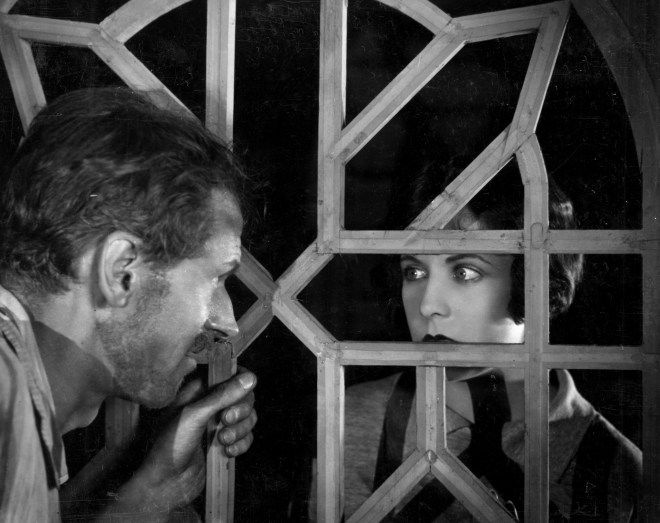
Alfred Hitchcock was already a film veteran when at just 25 he was offered the chance to direct his first motion picture by producer Michael Balcon. Starting out a few short years before as the guy that wrote and designed the intertitles that silent cinema relied on for dialogue and settings, he was now an art director, screenwriter and assistant director. His boss on these pictures was often the louche Graham Cutts, a man seemingly more interested in the ladies than making good films. On “The Blackguard” he even absconded with his latest mistress to leave Hitchcock to finish shooting the picture. This fantasy film about the dreams of a violinist was made at UFA studios in Germany, then at the forefront of movie technology. FW Murnau, one of the greats of silent cinema was literally making his masterpiece “The Last Laugh” on an adjoining soundstage.
Hitchcock would not be shy to draw upon the German style of film-making for his debut feature and would go on to film it in that country and Italy. “The Pleasure Garden”, based on a novel by Oliver Sandys (the pen-name of Marguerite Florence Barclay), is however resolutely a story of Britain and the Empire. The music hall that gives the film its title is in the West End and there are sequences set in West Africa. It’s a daring and confident debut, that owes much to a very good team around Hitchcock. Alongside the overweight and nervous young director was his editor, assistant and fiancee, Alma Reveille. A tiny and brilliant artist in her own right, both best friend and best collaborator of Hitchcock’s early years. The script had been prepared by Eliot Stannard, arguably the most accomplished screenwriter in 1920s British cinema (who would go onto to write all of the director’s silent films) and Hitchcock also had at his disposal two talented actresses from Hollywood: Virginia Valli and Carmelita Geraghty to play the leads who together put the female experience at the heart of the story. The two were friends, Geraghty had originally simply been Valli’s travelling companion and it was deemed more economical to hire her to act if the production was going to pay for her bed and board.
Charming and down-to-earth Patsy Brand (Valli) is a dancer at the Pleasure Garden music hall who takes in a naive but sexy country-girl Jill Cheyne (Geraghty), the victim of a theft. In an echo of real-life, Patsy gets Jill a roof over her head and a job on stage, where she attracts the attention of Hamilton the theatre manager. Jill is engaged to plantation worker, Hugh Fielding, but when he leaves for Africa, accepts a glamorous flat from Fielding who then pimps her out to a Russian prince. Jill meanwhile has rather inexplicably fallen in love with Hugh’s creepy friend, Levet and they marry on a very rainy day. Levet is not all he seems and when he too leaves for Africa, Patsy pines for a letter from him. When one arrives it sparks off a fatal chain of events in classic Hitchcock style.
What marks this film out is the characterisation, with real attention to detail and verisimilitude in costume and casting. Romantic and relatively prim Patsy is bluntly contrasted with the ambitious and wanton Jill, the old cockney couple who Patsy rents from are warm and cuddly, the epitome of domestic bliss in a sea of West End debauchery, while Hugh’s handsome vulnerability is set against the reptilian and suave Levet. Meanwhile there are flashes of real cinematic virtuosity where the director and his experienced cameraman Gaetano di Ventimiglia (the two would later brilliantly collaborate on “The Lodger”) toy with points of view and light and shadow and then harness some stunning Italian landscapes for Patsy’s honeymoon. It’s simultaneously both beautiful expressionistic AND classical film-making.
On its brief initial release in 1926 “The Pleasure Garden” gained good reviews, but was not widely seen until after the success of “The Lodger” the following year. Overlooked for decades owing to only cut versions being screened, the BFI restored a print, but it is not currently available on DVD. Luckily there’s one on Amazon Prime (again seemingly not the entire movie) that at least has restored a once lost (and happier) ending. It’s not a perfect film, and has some quite shocking moments, but it certainly deserves to be more widely known as the first quirky and entertaining step in a magnificent cinema career.

