“It may be that you are not yourself luminous, but you are a conductor of light. Some people without possessing genius have a remarkable power of stimulating it.” Sherlock Holmes (The Hound of the Baskervilles, 1901)
Always the master of the back-handed compliment, Sherlock Holmes here was (for once) talking up his fellow detective’s capabilities during their most notorious case. One where Dr John Watson actually gets the bulk of the action, with Holmes popping up in Dartmoor about half-way through to unravel the mystery. There are a few other moments where the genius sleuth deigns to compliment his sometime flatmate and (only) friend, but for the most part John has to put up with staying in Sherlock’s shadow: making notes for his published accounts, only to be at the receiving end of a cutting review from Holmes. What many forget is that the Sherlock Holmes stories are (with only a couple of exceptions) all written from Dr Watson’s point of view. The canon of mysteries are as much an account of the life of this wounded army veteran of the Second Afghan War (1878-1880), as they are of Holmes’s: the first novel “A Study in Scarlet” begins as John’s search for a flatmate upon his return to civilian life, and the sequel “The Sign of Four” sees him falling in love and getting married. The earlier adventures in The Strand Magazine from 1891-1893 often begin with a little update on where Watson is in his life, some predate his marriage, others see Mary Watson away from London, freeing him up for a day or two to help solve a murder.
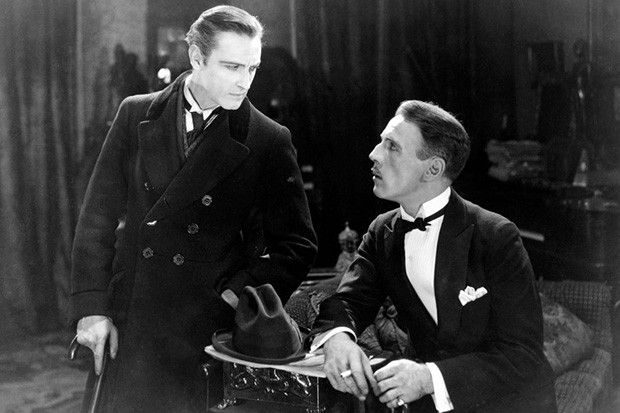
Doyle seemed unsure about keeping the doctor married permanently and upon Holmes’s return from the dead in “The Empty House” in 1903 it is implied that his wife has passed away and shortly afterwards John moves back into his former Baker Street lodgings. His commitment to general practice seems to flag too, often he dumps his own patients onto a partner in order to join Holmes on an escapade! Watson remains, frustratingly, a bit of an enigma, and there is only a smattering of descriptions of him in the texts. The Strand’s illustrator, Sidney Paget, took the logical route of depicting him as a sort of slimmed-down Conan Doyle and when it came to the earliest filmed versions of the stories, he appears only intermittently and to little dramatic effect. In the research for my documentary “A Case of Identity: How Cinema Helped Create Sherlock Holmes” I noticed that in transferring the cases to celluloid it takes away Watson’s purpose of both chronicler and confidante, as the movie camera effectively takes Watson’s place as storyteller. So on screen you then have to give the character something to DO. Many of the early filmmakers (including William Gillette – the first stage Holmes who filmed his own play in 1916) don’t bother. Either Watson doesn’t appear AT ALL or just stands around nodding while Sherlock explains something. It was only with the 1922 remake of Gillette’s film do we see the two men as friends and equals. John Barrymore and Roland Young (above) make one of the most youthful and debonair Holmes and Watsons in all of cinema – with even a controversial origin story of them meeting as Cambridge students taking up the first act of the screenplay. At the same time the British Stoll Studios were churning out short films based on the stories starring Eille Norwood and Hubert Willis, but both were far too old for the parts. Norwood at least has a brooding charisma, while the unfortunate Willis looks like a geriatric, befuddled school caretaker. Oddly the producers left the early story “The Sign of Four” to the end and to make Watson’s romance more convincing recast the part with the burly and masculine Arthur Cullen. Despite lacking the usual moustache Cullen has the build and swagger of the young Conan Doyle. But against the elderly Norwood seems young enough to be Holmes’s son.
Into the 1930s the role of Watson was played by a very wide variety of actors and the talkies really helped depict the camaraderie between him and his friend. The best Doctors of this era are matched in age with their Holmes’s and display the wit and humanity missing in the detective. Athole Stewart and Ian Fleming both got to play the part in 1931. Stewart’s Watson is a tall, prematurely bald, charming posh boy, ribbing his Holmes (Raymond Massey) in the entertaining “The Speckled Band” with all the banter of a member of the same rugby team. Fleming (no relation to the creator of James Bond) meanwhile is a cheeky and debonair little comic relief, the spitting image of a middle-aged Charlie Chaplin, who would go onto to make 4 movies with his Holmes, Arthur Wontner. Unlike many other Watsons he’s eventually given a complete backstory as a practising (and married) medical man and plenty of agency in many of the films. Considering his importance to the Holmes ouevre, it’s remarkable how rare this faithfulness to the character was in these early movies. Throughout the rest of the century on film and TV Watson would be depicted as a bumbling oaf by Nigel Bruce and Nigel Stock, a dashing sidekick by Andre Morrell, and a thoughtful father-figure by James Mason. Then, most accurately in the Granada TV series of the 1980s, where David Burke (followed by Edward Hardwicke) reinvented the role as both a believable friend and a brave and resourceful reporter for Jeremy Brett’s Holmes and his career.
A CASE OF IDENTITY: How Cinema Helped Create Sherlock Holmes is now available on YouTube.

