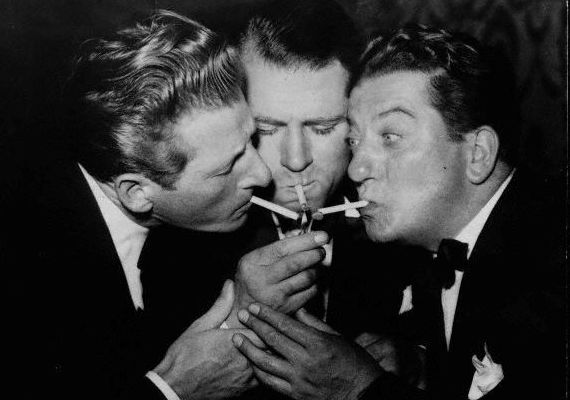
Recently updating my talk on now largely forgotten comic Sid Field it’s become clear that the 3 huge West End variety shows during and just after World War II he starred in truly helped kick-start the post-war comedy boom. Dozens of hungry, young and demobbed wannabe entertainers flocked to London and Sid was the top act in town. Among them were Tony Hancock, Spike Milligan, Kenneth Williams and Frankie Howerd and what they saw would help shape the future of British comedy. It was character-based and it was camp.
Here’s “Portrait Study” from Sid’s second West End hit show, “Strike It Again” as it was later filmed for the movie “London Town” (1946). Sadly lacking the atmosphere of the live performance, this sketch still remains a very daring depiction of camp. Perhaps there was a touch of self-awareness about the edgy nature of the piece, Martin Lane is the credited writer, but this is a pseudonym for humourist Basil Boothroyd. St Martin’s Lane near Covent Garden, being a famously gay-friendly part of the capital since the days of Oscar Wilde. The characters Field and his regular foil, Jerry Desmonde beautifully play, clearly have a very close relationship and their obsession with appearance and manners displays all the mid-century cliches of homosexuality, but it’s nothing overt. If you listen to the BBC recording of the live show, its clear the audience were in on the joke. However, the film-makers choked and “London Town” bizarrely ends with Field’s (heterosexual) love-interest in the film, 19 year old Kay Kendall, breaking the fourth wall to reassure the audience that Sid himself, not the character he plays, is all man. All slightly undermined by a very chaste kiss and their mincing off arm in arm. It’s an odd climax to a very confusing film, which was cut when the nationwide release required 30 minutes sliced off the 2 hour running time. Or perhaps a smart editor saw sense. Despite all these efforts at “damage limitation” the American censors took one look at “Portrait Study”, took offence at its campness and denied the film a release in the US. They were no fun.
So, what is “camp”? It’s a revelling in sexual ambiguity, a game that exists between performer and spectator. It’s a wink and a wiggle. But how far back does it go? The French have a phrase se camper, meaning “to pose in an exaggerated fashion”. Moliere, Shakespeare, Chaucer, even Roman comedies all have their very camp moments. Eighteenth-century dandies were extremely camp. The cross-dressing of Victorian panto was camp for kids. The English music hall was laden with sexual innuendo and there are plenty of moments in Chaplin’s films when he’s not adverse to mincing about. But homosexual camp, albeit portrayed by two happily married straight guys, really hit the mainstream with Field’s sketch. In its wake would come a wave of unadulterated, liberated campness from Frankie Howerd, Larry Grayson and Jon Inman. Toying with what was both decent and legal pre 1967, but building a tradition of knowing comedy performance from the stage to film to TV, that works on a variety of levels and still exists (perhaps controversially) to this day.
So, can we call Sid Field a camp comedian? The famously hard-to-please Kenneth Williams, watching him on stage at the London Palladium in 1948 certainly did. In his diary he wrote that Field “was marvellous, and received terrific and well-merited applause – what camping! I simply roared”. The effeminate duo of Julian and Sandy, played by Williams and Hugh Paddick created for the radio series “Round The Horne” in 1965, I would argue owe much to “Portrait Study”. Overall though, Sid played it safe. There’s a childlike nature to all of his comedy characters that harks back to influences like Stan Laurel and Oliver Hardy, who Sid would meet in 1947. There is little real innuendo or hint of grown-up sexuality, Sid Field was simply out to just make people laugh, like Stan and Ollie, not to offend or challenge the status quo. Even if he flirted with the limits of what was allowed at the time.
Interestingly, Sid’s own public persona was a bit more flamboyant, what we today would call “metrosexual”. Moving to London and becoming a huge star in the mid 1940s, he was often seen out on the town with famous faces. There are photos of him camping it up with bisexual stars Danny Kaye and Laurence Olivier (who named Field as one of his greatest influences), then a secret couple. Field sort of mentored Kaye on his first trip to London, where Kaye would take over Field’s Palladium gig that Williams saw. They became very close, sharing the same absurd sense of humour, Kaye’s pet name for Field was “Cocky” and Field would write a gushing forward to Kaye’s first biography. Kaye in turn would go on to produce the Sid Field Tribute Show a year after his friend’s premature death in 1950. However Field (unlike Kaye) was happily married with 3 kids and by all accounts led a rather boring private life, playing golf, eating shepherd’s pie and keeping dogs and rabbits at home. My feeling is he was just using a bit of camp for publicity purposes when it was required, which shows how acceptable a little sexual ambiguity was 80 years ago.

