The release of the 8th movie in the “Mission Impossible” series: “The Final Reckoning” is a cause for celebration. Not only is it an exciting and funny return to form for the franchise, after the muddled and underwhelming “Dead Reckoning”, but it also gives us a chance to spot another of producer/star Tom Cruise’s slapstick comedy callbacks. Cruise is well known for his encyclopaedic knowledge of film history. This has not only helped him select (and bond with) some of the most illustrious names in cinema to direct each M:I chapter (from Brian de Palma to John Woo and Christopher McQuarrie), but also to pepper the films with tributes to his own acting heroes from a century ago. Three geniuses whose work shared a common theme: the little man against the forces of the universe.
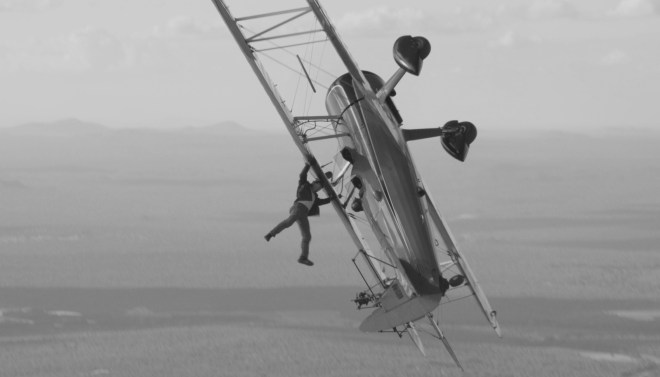
The latest example of this is in the thrilling biplane chase finale to “The Final Reckoning” where Cruise’s Ethan Hunt manages to catch-up with the villain Gabriel’s plane, but also to leap aboard mid-air and then end up hanging from the seat belt as the plane does various insane flips and turns. And it’s here where (albeit on a grander budget and with the star actually doing the stunt) we get an exciting and hilarious echo of this charming sequence from Charlie Chaplin’s “The Great Dictator” (1940).
Now, this is pure speculation on my part, and it’s not been picked up by any reviewers, but Cruise has always adored Chaplin, he even did impressions of the comic as a child and was allegedly offered the lead role in Richard Attenborough’s “Chaplin” (1992) (although he turned it down), so perhaps this scene was one inspiration. However, unlike the 62 year old Cruise, the 50 year old Chaplin here does not attempt anything too dangerous and it’s obvious the scene is largely studio-based and clearly features beautifully-made toys. Far more relevant are the real-time, in-camera stunts of fellow silent comedians Harold Lloyd and Buster Keaton – regularly revisited in the M:I series – to the extent where Cruise almost replicated one of Keaton’s most famous falls. In a chase across rooftops in “The Three Ages” (1923) Keaton missed the next building, and spent 3 days in bed recovering. The miss was added into the action and Keaton improvised a whole new series of gags. Over 80 years later, while filming in London the sixth “Mission Impossible” movie: “Fallout”, Cruise attempted an almost identical jump and similarly missed, smashing into a wall and breaking his ankle. The actor has a noticeable limp in some existing footage.
Buster Keaton was rarely credited as the sole director of his movies (Cruise never has) but (like Cruise) remained the creative lead for the choice of crew, gags and stunts throughout the 1920s. In keeping with his modern counterpart, he was obsessed with both kinetic momentum and realism, and if he wanted a train to crash into a river or a building to fall on top of him, he would find a way to make it actually happen on film, all with the scrupulous accuracy of the engineer he secretly wanted to be. One injury Cruise has not happily suffered from is breaking his neck. However, during the making of “Sherlock Junior” (1924) this is what happened to Buster. As seen in so many of the M:I series there is a scene running along the top of a train, but in this case Keaton gets caught in a heavy outflow from a water tower which pushes him onto the tracks, before (wetly) getting up and running away. In the 1950s a doctor asked him when he’d fractured his neck, and the only thing that Buster could recall was that day when he landed heavily on that railway, carried on filming and then suffered from severe headaches for a time after.
Harold Lloyd’s persona is probably the most similar to Cruise’s. The charming and dapper everyman he played has a more human reaction to his unbelievable predicaments than the stoic, stone-faced Keaton. Like Ethan Hunt he actually gets scared, but also displays a similar resourcefulness, agility and will to survive. And like both Keaton and Cruise, he meticulously planned each stunt for maximum effect but minimum danger (and did use stuntmen for some longshots). Lloyd was haunted by a near-fatal accident in 1919, where a mis-timed fuse on a prop-bomb blew off half his right hand. For all of these clever, extraordinary film-makers, knowing their value as box-office stars, it was (usually) a case of safety first, not safety last.

