Please note: there are a few spoilers below!
The older I get the more I identify with and adore both the character and the film “Shirley Valentine”. Based on Willy Russell’s play of the same name, this 1989 movie directed by Lewis Gilbert and starring Pauline Collins, who recently died aged 85, has a unique place in my cinematic affections. It’s not hard to see why. It’s one of the best acted British comedies ever made, a script that crackles with genius one-liners and Gilbert’s opening out of the action to real locations in Mykonos is the closest you can get to a wonderful sunny holiday on a cold, rainy night in front of the telly in Norbiton. You can taste the feta in that Greek salad.
The initial setting is as ordinary as can be, suburban Liverpool in the script, but actually filmed at various locations, it’s typical semi-detached 1980s sitcom territory. A simple story of the marriage of Shirley and Joe (Bernard Hill): from moving in and decorating their new house with paint and laughter as newlyweds to 20 years later when the laughter has stopped. To be replaced by a boring routine of loneliness, neglect and abuse. As in the original one-woman play, Shirley’s life has shrank to shopping, cooking and talking to her kitchen wall with a glass of wine in her hand. The scene where Joe refuses to eat chips and egg instead of the steak he was promised on a Thursday is absurd, unsettling and chillingly believable. It’s dark comedy with a hint of violence. And is the spark for Shirley’s act of defiance: a holiday with her best mate to Greece. Much lighter are Shirley’s reminiscences (to us and the wall) about her rebellious schooldays and her rivalry with the glamorous school swot, Marjorie Majors. Played as an adult by the luminous Joanna Lumley there is an hilarious twist (which I won’t spoil) where she reveals her career didn’t quite move into being the air hostess Shirley had imagined her to be.
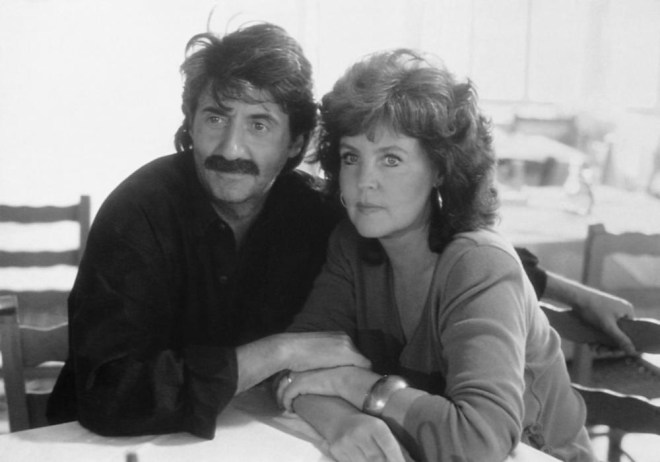
Julia McKenzie and Alison Steadman add yet more comedic power to this (rare for its time) female-centred narrative, but it’s Collins who simply seizes the movie and carries us along on her act of rebellion. She IS the movie in a way that Marilyn or Liz Taylor define their films. Cheeky and brave, yet vulnerable, she has true star quality. In less than 90 minutes she transforms, maturing into a new Hellenic independent persona, her eyes getting bluer and her skin browner, to the extent that Hill’s Joe (finally convinced by their son to go out a visit Shirley who has stayed in Greece for good) fails to recognise her at a cafe. And it’s all brilliantly filmed. Gilbert (a veteran director of no less than 3 Bond movies) gives us the sharp contrast of an England where it is constantly raining and a Greece where the skies are always cobalt blue and the houses startlingly white. For anyone who has been on a Greek holiday (and I’ve been on a few) it remains both warmly nostalgic and familiar. Yes, maybe Tom Conti does ham it up as a randy Greek waiter, but I can forgive such a loveable performance.
The bittersweet climax where Shirley and Joe are reunited shows how the power dynamic in their relationship has completely shifted: Shirley is a glamorous stranger to him now, her steely confidence summed up with a look to camera of both determination and sadness; Joe is a little boy lost weighed down by an old suitcase, unaware of the life-changing news that is likely to hit him. It will have you speculating for hours about what happens next. Collins went onto a busy career after, but nothing could top this. There is so much to admire about this film and her performance. Once you’ve seen Shirley in action, she’ll never leave you.

