Edgar Wright’s “The Running Man” rushes into cinemas on the heels of not one, but two movies carrying the same title. In 1987 an earlier version of the orginal 1982 novel the movie was based upon had been released starring Arnold Schwarzenegger, then in his first wave of super-stardom. Previous to this an entirely unrelated film was made in 1963 starring Laurence Harvey, but I’m also exploring this as it’s an overlooked gem you should check out, it coincidentally shares a few themes with its namesakes and like them epitomises the action/thriller genre of its time.
The latest “The Running Man” starring Glen Powell, is a pretty faithful adaptation of Stephen King’s book, written under the pseudonym of Richard Bachman in the early 1970s and actually set in the dystopian future of 2025. Both movie and novel follow Ben Richards, an unemployed father of a sick daughter. To pay for her medical treatment he volunteers for a dangerous TV show “The Running Man” where contestants are given a 12 hour head start as they are set free into the world, before a team of hunters are despatched to capture and kill. Money is awarded for each day they stay alive, but they have to mail in video cassettes daily to qualify. Owing to both ingenuity and luck Richards breaks records in evading capture, which brings him unprecedented popularity with the viewers. The movie has the advantage of hindsight in knowing exactly what 2025 is really like, but Wright and co-writer Michael Bacall come seriously unstuck with this. Instead of setting the movie in the real 2025 of mobile phones, constant surveillance and Donald Trump, they stay true to the events of the novel, concocting a non-digital fantasy present that fails to hang together as a believable universe. In this world there is one TV channel, that controls both the news and (it’s implied) the government. The issue with this, is that it’s a pretty vanilla dystopia, compared to what is happening today in a USA of immigration crackdowns, sex traffickers, and huge medical bills. And yes, billionaires ARE now buying up TV networks, movie studios and social media, all to promote a neo-liberal agenda and to stifle freedom of speech and access to live-streamed international war crimes they themselves profit from. Led by a wooden protagonist with anger-management issues, it’s a rather disappointing movie that is only mildly satirical, staggers (rather than runs) from one action sequence to another, and tags on an optimistic ending that isn’t in the book.
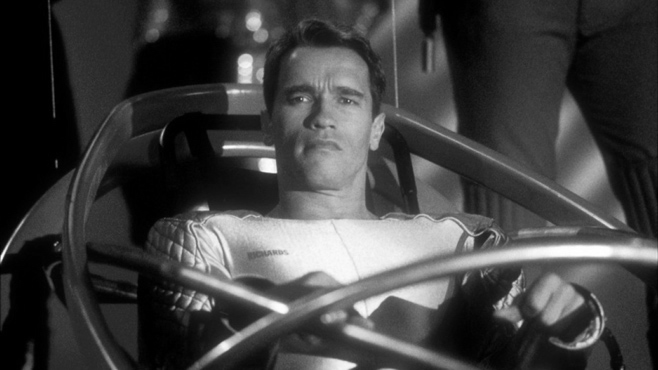
Far darker and (weirdly) more prescient is the outwardly sci-fi approach of the 1987 version. Paul-Michael Glaser’s movie is the ultimate 80s action flick and kicks out King’s original plot, retaining just character names and a version of the TV show. Set in 2017, we meet a different Richards, a helicopter pilot with no family, framed for an attack on unarmed protestors. In reality he tried to stop the massacre, which today starkly evokes videos from Gaza. In another chilling twist, the presenter of “The Running Man” TV’s top-rated gameshow is an elderly, tanned meglomaniac with the US government in his pocket and the power of life and death over all citizens. Compared to the 2025 remake, there is a more cinematic attempt to depict this broken, divided society, and with a bit of humour. Sure it’s bizarre seeing rockstar Mick Fleetwood aged up to depict himself as a venerable resistance leader (bizarrely looking a bit like Jeremy Corbyn), but it’s an amusing bit of shorthand to sum up the anger around the censoring of music and TV. What is also an improvement is its foregrounding of female voices, from the delightful audience of blood-thirsty grannies cheering on the hunters to Maria Conchita Alonso’s chippy jingle-writer, Amber Mendez, who teams up with Arnie’s Richards. It’s a distinctive, disco-influenced vision of the future, choreographed by Paula Abdul and scored by the untouchable Harold Faltermeyer with one of his most epic electronic scores. Meanwhile, Wright’s drab alternative present (enlivened by TV shows that look almost interchangeable from the 1987 movie) is accompanied by forgettable pop tunes and lacks the banger of an original song to end its movie. Step forward Mr John Parr.
Unlike these two blockbusters, 1963’s “The Running Man”, directed by British auteur Carol Reed, is a down-to-earth thriller, but there are a few parallels. It too, is based on a novel (by Shelley Smith), the protagonist is another pilot, making a rash move when he feels he has no other choice and looking to take revenge on the wider world. Rex Black (Laurence Harvey) connives with his wife (Lee Remick) to fake his own death, only to re-invent himself months later in Spain, where the couple will be reunited and they can live off the life insurance. There is a hunter too (or so Rex thinks) in the form of young insurance clerk Alan Bates who happens to turn up in Malaga and threatens to expose the crime. Like the two later movies, this is very much of its time and like Schwarzenegger, Harvey was a hugely charismatic and charming movie star with a hint of menace who can carry a picture. I’m not sure we can say that of Glen Powell to be honest. One other theme it also shares is the toying with reality. In both the 1987 and 2025 productions video is manipulated to depict the brave underdog Richards as the villain to the fictional TV audience, in 1963 it was the real cinema audience having its perspective and its sympathies twisted: is Rex a hero, the little guy getting one up on the stuffy British establishment, or is he just a greedy sociopath?
By happy accident, each film does seem to sum up its own time and culture. Wright’s rather depressing and lumbering movie is very 2020s. It is full of today’s despair, anger and confusion and the desperate need to seek solace in the output of the past. Wright is a director who constantly looks backwards, and the film is hobbled by an oddly charmless sense of nostalgia. Glaser’s showy, shorter blast of 80s sci-fi kitsch, hasn’t much time to dwell on the bigger picture and confidently revels in its own violence and absurdity. And unlike with the remake, thanks to kinetic editing and that pumping soundtrack (all so typical of its era), there is a sense of peril and urgency that does cut through the silliness. Meanwhile Reed’s elegant effort is a paean to the cinema cliches of his time: it starts out in the crammed attic flats and shabby insurance offices of a kitchen sink drama, before opening out onto a wider, brighter canvas. Made the year after “Dr No”, this first “Running Man” has a hugely Bondian flavour, Maurice Binder even provides the stunning animated titles. Its car chases, stunts, glamorous women and real sun-drenched technicolor European locations ARE also a vision of the future – of what the 007 franchise will become. A series of colourful, fantastical box office hits that will lead to the blockbusters of later decades like “The Running Man” (1987 and 2025).

