Thirty years ago on the evening of 27th May 1996, a Bank Holiday Monday, I was sitting in the Putney studio flat of two old university friends watching TV. We’d all moved to London the previous year after a failed attempt to run a theatre company. Basically, we’d graduated, gone on the dole, put on a few plays and discovered we weren’t as talented as we’d all thought we were. I was now depressingly living alone in an Ealing bedsit with a tiny black and white TV, working in a bookshop and receiving regular rejection letters from every theatre in Britain. My pals had fared better, one working for a museum and her boyfriend in music promotion. It was unusual for me to watch TV with them, their flat was small and I was spending most of my evenings drinking in Soho with literary types or doing stage management and lighting for an am-dram group. Yes, it was a bit of an imposition, but the offering on BBC1 that night was something special and I wanted to see it in colour and with people. Watching telly on your own is rubbish, and this was a bit of TV history that needed to be shared and discussed with geeky chums. It was the return (after 7 years) of “Doctor Who”.
The programme had run consistently from 1963 to 1989, 26 seasons of monsters and travels through time and space. 8 actors had played the eponymous character: William Hartnell, Patrick Troughton, Jon Pertwee, Tom Baker, Peter Davison, Colin Baker and Sylvester McCoy (with Richard Hurndall stepping in to replace Hartnell for an anniversary special). Like Blue Peter or Top of the Pops it felt like a permanent fixture in the BBC1 schedule, but in the 1980s tastes were changing. It had never been beloved by BBC bosses, often pretty much ignored, but in 1985 following an underwhelming 22nd season that veered into violent video-nasty territory they finally axed the show. I was 13 and a bit shocked, but not surprised. They seemed to be trying to appeal to an older audience, with longer episodes, a sexy new companion who didn’t wear much and a doctor who dressed like a clown but gunned down villains like he was Charles Bronson. It wasn’t fun anymore. After an outcry, it was given a stay of execution for a few more years, but after they stuck the show against Corrie on a Wednesday night, the writing was truly on the wall. Despite some great scripts in its final year, the programme looked cheap and tired and the final episode broadcast: “Survival” Episode 3 would go out on 6th December 1989. The Doctor couldn’t compete with the Duckworths.
Not all TV series have a divine right to run forever. It’s best they don’t. Even soaps get canned. But “Doctor Who” was such a brilliantly versatile concept, with a huge heritage of characters, alien races and plotlines, after ’89 it was never just going to be forgotten. Novels and comics kept it in the public eye: new stories written by young fans who simply wanted to know what happened next in the Doctor’s story. Without new Who on TV a whole industry of nostalgia sprung up: VHS cassettes, magazines, posters, calendars – all sold at a string of conventions attended by the ageing stars of the show. The 30th anniversary in 1993 was marked by a reunion of sorts with a Children in Need sketch where all the surviving Doctors were chased about by cybermen and sea devils on the set of Eastenders. It made utterly no sense and (I thought) was the final nail in the coffin of a once great programme that had had its day. This was the tone of a university essay I submitted as part of my film studies course the following year: good show, but ultimately it became too wrapped up in its own legend to find a new audience and probably deserved to die. Very weirdly, it still clung on, following me about. 1995 saw me and my fellow theatre company actors taking part in an ambitious Doctor Who spinoff filmed at our old university campus. Something that would never appear on TV, no, a “straight-to-video-feature-length adventure” called “Downtime” to be sold at conventions. It was great fun being an extra alongside old stars of the show I’d grown up watching. And I got my picture taken with a yeti. But, surely that was it…?
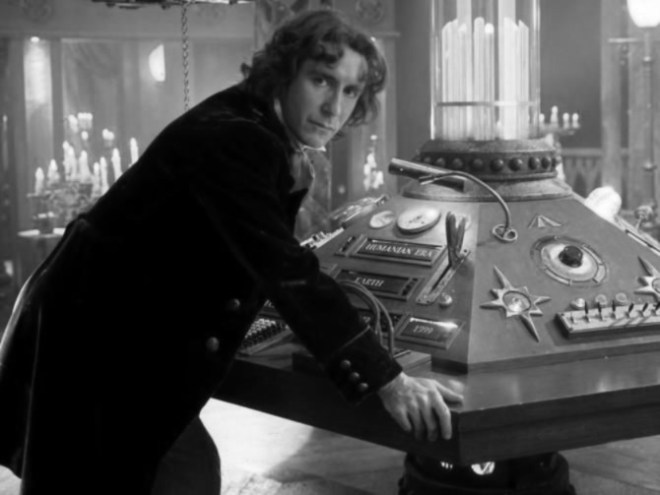
Not at all. Barely a year later I was I on a sofa eating carrot sticks and hummus in Putney watching a whole new episode of actual “Doctor Who”. And the hype was massive. Surprisingly. Radio Times gave the show its cover. It had a trailer that looked fantastic with the witty slogan “He’s back! And it’s about time!” The book of the film and the VHS video I seem to recall were already in the shops before it had even been on TV. It was everywhere and the actor at the front of this sci-fi juggernaut was a great choice, the “I” of “Withnail and I”: Paul McGann. A busy, versatile and charming actor, McGann hails from Liverpool and turned up on set in Vancouver with his cropped hair fresh from the TV version of SAS drama “Bravo Two Zero”. Unfortunately, he’d got the part sporting a Byronic mop of long curls (see above), hence the unsightly wig that was plonked on his head giving him the appearance of a Cocker Spaniel. Hairpiece aside, he was great in the part. Not a tall actor, he was more in the mould of Hartnell and Troughton, more vulnerable and approachable Time Lords than the patrician and aloof performances from the taller Pertwee, Bakers and Davison that came later. Also positive was the handover from 1989’s doctor, Sylvester McCoy, keeping the continuity going with a proper regeneration and then there was the TARDIS. Wow. The beautiful police-box exterior an exact reproduction of what had come before, while the interior was brand-new, replacing the sterile plastic of the 1980s console room with a steam-punk-cathedral look, kind of Dracula meets HG Wells.
All filmed by British director Geoffrey Sax in that slightly foggy, glowy, skew-whiff style of the X-Files and set in San Francisco on New Year’s Eve 1999 (people were panicking about “Millennium bugs” at the time), as the movie unfolded it felt very contemporary and very American. There is a rather tenuous and confusing storyline about the Doctor taking the remains of his executed fellow Time Lord, The Master, home, who escapes as a magic snake and plans to steal the TARDS and the Doctor’s remaining lives at the stroke of midnight at the turn of the millennium. In doing so he threatens to turn the universe inside out. The bonkers plot is matched by Eric Roberts’ bonkers take on the Doctor’s old enemy, possessing the body of an ambulance driver. Also along for the ride is sexy redhead and actual doctor, Grace (played by Daphne Ashbrook) who gives our hero his first proper snog since 1963. I’m not sure any of us were quite ready for these massive departures from the tone of the original series and neither of my fellow viewers liked it very much. I, on the other hand, adored it. And three decades on I still do. Although Fox TV didn’t take this pilot further, it remained a fun and brave attempt to reboot the show and was seen by 8 million UK viewers. In hindsight, it was probably a premature and too Americanised experiment, although still weighed down with fan-pleasing continuity callbacks as it was in the 1980s; a longer rest and a bigger rethink for the show was needed. It would ultimately pave the way for a British-based return to TV in 2005. This time we would get a whole series, starring Christopher Eccleston as a new incarnation, who WOULD be allowed to have his hair cut very short. No silly wigs required.
Doctor Who: The Movie has been restored in 4K and is available now.

