In February 2027 a 50 year old science fiction movie will be re-released in cinemas. This means there is the same amount of time between today and 1977 as between 1977 and the era of “The Jazz Singer” starring Al Jolson. The film is “Star Wars”, and it’s going to be a different film to the one you have probably seen on TV or DVD. It’s not a Special Edition, it won’t have a subtitle, there is no “New Hope”, nor is it Episode 4 of a 9 part saga. This will be the original cut of a one-off, experimental, rough around the edges, space western produced in Britain and Tunisia by George Lucas, a young Californian writer-director who had only made 2 other movies, a film so dogged by bad luck and disorganisation that it was virtually disowned before it was even released by a confused cast and crew. However, we know now it would become the biggest box-office success of its time, start a franchise of further films and TV series and rewrite the Hollywood rulebook, bringing back fantastical film-making on a grand scale. It’s unarguable that we would never have had 5 Indiana Jones adventures, a dozen Star Trek movies, 8 Supermans, multiple Batmans and Spidermans or the seemingly endless Alien franchise without the financial and critical success of Lucas’s blockbuster.
The story of “Star Wars” has been the subject of a universe of books and documentaries, so it is worth just sitting down and watching the movie again. Unfortunately the only version you can actually see is not what was released “a long time ago” in 1977. To celebrate the film’s 20th anniversary Lucas released a “Special Edition”, saying it fixed a lot of the technical issues of the original (which was withdrawn from circulation) with cutting-edge new special effects. Actually, it was more to treat this classic film as a test-bed for the CGI he had planned for the “prequel trilogy” going into production. The result was that rather than being an extended or restored director’s cut, it took many of the lovingly-crafted model and puppet shots that gives “Star Wars” a truly grounded and lived-in feel, where the fantastical looks real, because it IS, and replaced them with experimental cartoon aliens and ships. Now, the film is simply too exciting and the performances across the board are too damn charming to completely fuck up, but (especially on the desert world of Tatooine) it does feel at times like Warner Brothers re-releasing “The Adventures of Robin Hood” and sticking in Bugs Bunny and Daffy Duck alongside Errol Flynn.
Ranting about badly rendered Dewbacks aside, “Star Wars” remains a truly great movie. Most critics in 1977 agreed with Time Magazine’s glowing and perceptive review, calling it “a remarkable confection: a subliminal history of the movies, wrapped in a riveting tale of suspense and adventure… it’s aimed at the kid in everybody.” It is a hugely literate and clever film, nominated for 10 Oscars and winning 6, with Lucas drawing on his deep understanding of books and cinema. His early drafts of the script from 1973 drew largely from a favourite samurai movie, Akira Kurosawa’s “The Hidden Fortress” (1958), which would give him 2 bickering servants (a fat one and thin one), a feisty princess and the idea of a noble knight on a quest, but this was merely the start. The sci-fi trappings are drawn from the 1930s Flash Gordon serials that were re-run on TV during Lucas’s childhood, the “Lensmen” novels of EE Smith and the works of Edgar Rice Burroughs, Isaac Asimov and Frank Herbert. Then you have the shadow of the American Western, particularly John Ford’s “The Searchers” (1956), where our heroes discover a desert homestead in flames and subsequently head out on an epic rescue mission. One jarring echo of these influences is its lack of female representation. Unlike many of his contemporaries, Lucas remained an essentially conservative film-maker and his Eisenhower-era worldview comes across in the boy’s club of “Star Wars” where amongst a cast of dozens, there are just two female performers with lines: Carrie Fisher and Shelagh Fraser. It’s completely bizarre that neither in the Death Star nor at the rebel base are there any female staff, whist even in the sleazy Mos Eisley bar, Lucas couldn’t bear to cast at least one woman serving the drinks. There are many war films of the 1940s that pass the Bechdel Test better than this.
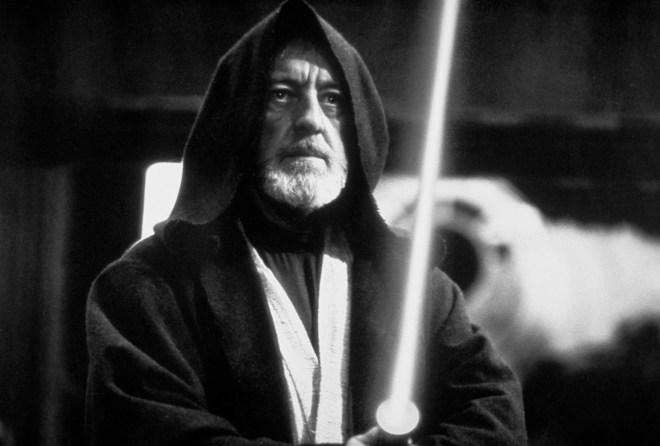
So, why did it succeed so well, back in 1977? As I’ve explained, it was both a glimpse of the future of cinema, but also a nod to its past. And two very important elements of that past are 1) sound and 2) stars. The sound-scape of “Star Wars” is unique. Aliens and droids from Lucas’s imagination had to be given voices (or beeps and grunts), the noise of a laser blaster or when two light sabres clash had to be created and then, how on earth do you score a film, set not on the earth and centuries ago? It was a creative and technological leap that half a century after the first talkies were released, took how cinema is heard into a new era. Lucas created a new company called THX to oversee and further develop this, eventually improving the sound quality for all films in cinemas across the world. Meanwhile, John Williams rehabilitated the classical orchestral score with his lush, playful and epic soundtrack that evokes the great composers of the nineteenth century, whilst still adding to the atmosphere of a truly modern film. As for stars, “Star Wars” made 3 attractive, but completely obscure young actors: Mark Hamill, Harrison Ford and Carrie Fisher into household names, whilst resting much of the exposition and drama on one older and more established figure. Watching “Star Wars” again recently, I realised this time it’s very much Alec Guinness’s film. As old jedi knight, Ben Kenobi, he steals every scene he’s in and basically narrates most of the first half of the movie; a reassuring, familiar Hollywood figure explaining this unfamiliar galaxy to the audience, moving the action along in his brave quest to rescue Fisher’s Princess Leia from the Empire and finally disarming it’s super-weapon, the Death Star. Kenobi is the heart and soul of the picture and Guinness’s winning portrayal got him an Oscar nomination. He also negotiated a cheeky cut of the profits, so it left him a very rich man (although as he also stated in the Parkinson interview above, the recipient of some “strange letters”). On my first day working at Hatchard’s bookshop back in 1995 I literally bumped into him wearing his usual black hat and overcoat. He lived just around the corner and after I apologised and asked if he needed any help, he just smiled with that twinkle in his eye, lifted his arm and left the shop without paying for the book he was holding. I think I said “he doesn’t need to pay for that book” to a colleague, but my memory is a little hazy.

