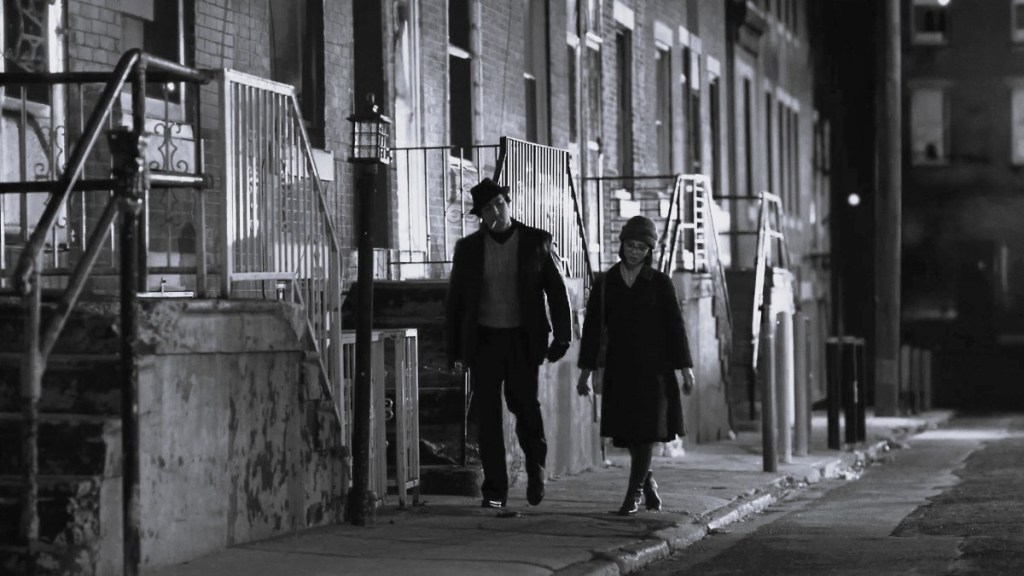
SPOILERS AHEAD! “Rocky” (1976) is one of those iconic films that seems always to have existed. Like any true classic of cinema it’s sometimes hard to imagine that somebody sat down and wrote the script. That “somebody” was a 30 year old nobody, a struggling actor called Sylvester Stallone, working as an LA car parking attendant with only a handful of bit parts in Hollywood on his cv. Thanks to his own stubbornness and the vision of two experienced movie producers, Robert Chartoff and Irwin Winkler, “Rocky” was made, largely on location in Philadelphia on a relatively tiny budget of $1million. It became the highest grossing film in the world in 1976 and one three Oscars including Best Picture. The “ultimate underdog story” of a fading fighter given a shot at the World Boxing Title it drew on the mythos of the American dream at the time of the country’s bicentennial, offering a tale of hope that even the unlikeliest and humblest of men can find romance and success. With a country reeling from Vietnam and Watergate, this movie caught the cultural wave of a need for optimistic stories, that transcended race and background, putting power back in the hands of the little guy. Of course, it’s a fairy tale, but remains a brilliantly written one with a superb cast and a very canny, streetwise director in John G. Avildsen, and one that (remarkably) mirrored real life. Its unlikely path to the screen is the subject of Peter Farrelly’s new movie “I Play Rocky”, a highly entertaining dramatization of Stallone’s struggles as an actor and how (as in “Rocky”) with a combination of raw talent, dumb luck and the love of a good woman, he gets a shot at the big time.
Farrelly and screenwriter Peter Gamble don’t have to stray far from the truth and wisely don’t attempt to remake “Rocky” itself. It lacks the gritty intensity, and the bombastic score, instead we have a lighter and more comedic account of a man on the ropes, whose own father (played by a reptilian Matt Dillon) calls him a moron in front of his new girlfriend and has to demean himself in a porno to pay the rent. Antony Ippolito submitted self-tapes to the film-makers doing Stallone impressions as soon as the production was announced and its not hard to see why he was cast in the lead role. Bulked up he is the spitting image of “Sly” with the same vocal drawl, it’s a magnificent achievement, bearing in mind he had to learn to box too! AnnaSophia Robb steals the film as the forgotten woman of the Rocky myth, Stallone’s first wife Sasha, who meets him as they both usher at a cinema and went on to type up and edit the screenplay. Robb makes a sparky, sarcastic foil to Ippolito’s necessarily slow, focussed performance. Equally impressive is the hilarious Stephan James as Carl Weathers, audaciously striding into his audition to play Heavyweight Champion, Apollo Creed, almost topless. Not unexpected from the director of “Shallow Hal” is that there is a ton of humour throughout: my favourite running gag is when the lead actors all have to admit to their director that they lack skills crucial to the film, from ice-skating to boxing itself (Stallone knew next to nothing about the sport), while zany recreations of the on-the-fly, low-budget filming evoke the Steve Martin slapstick classic “Bowfinger”.
So, what happened next? I’d really recommend the Netflix feature-length documentary “Sly” to put “Rocky” and its sequels in context. Faced with unprecedented and unexpected success, the film shows how Stallone was able to bring to the screen two of his other screenplays: “F.I.ST.” and his directorial debut “Paradise Alley”, both hard-boiled period dramas with a hint of Coppola or Leone depicting working class life 40 years before. Neither were a success which brings us (inevitably) to “Rocky II” (1979). Hollywood sequels were never a sure thing at the box office, but “Jaws 2” (1978) proved that lightning could strike twice and with Rocky’s brilliant cast signed up to continue the story, surely it would be a hit. And it was. However, the film suffers from Stallone’s inexperience as a director, it’s a short film, but very slow, Talia Shire’s Adrian slips into a coma after the birth of Rocky Junior and as we take in Rocky’s trauma and worry, the action simply stops. The rematch with Creed is fabulously choreographed and edited (which took months), but deserves more screen time. It remains amongst Stallone’s favourite films, because (as we see in the documentary) he is obsessed with a happy ending, but I prefer “Rocky III” (1982). Stallone is a more confident director here, this is a big, ambitious movie that escapes from the storylines and settings of its predecessors. Stallone physically changes too, he appears leaner and taller, dressed in the sharp suits of a world champion athlete and celebrity. It’s easily the slickest film in the franchise and the one where Stallone and Rocky become almost interchangeable personalities – Stallone’s frequent TV appearances are recycled in a montage to show Rocky’s growing fame and confidence. Unlike “II” both Shire and Burt Young as Adrian’s brother Paulie are ringside to see the former champ defeat his nemesis, Mr T’s wonderfully obnoxious Clubber Lang, with Rocky guided by the ever-charming Carl Weathers.
There was never supposed to be a “Rocky IV”, “Rocky III” ends a trilogy of films on a high, the Balboas have a son, Rocky is champ again and the former champ, Apollo, has found some meaning to his retirement. Maybe time for Stallone to try something new? So he took on John Rambo. The troubled, taciturn Vietnam vet would appear in two huge movies before Stallone and his hungry ego brought back Balboa in a bombastic, bonkers third sequel. “Rocky IV” is less of a movie, more of a sequence of music-video montages, with usual composer Bill Conti replaced by the more synthesised style of Vince diCola and some great 80s rock. It contains some true drama, but our familiar cast are lost in the set pieces and it’s over in a flash of running about, two epic boxing fights and some cheesy political platitudes. Another huge hit of course, leading eventually to “Rocky V” in 1990 and “Rocky VI” (aka “Rocky Balboa”) in 2006, bringing the characters down to earth. After his investments go under, Rocky returns to his hometown living modestly and attempting to forge a relationship with his growing son. “V” is notable as it sees the return of Avildsen as director and Conti as composer and we get back to the dirty streets of Philly. It’s a very intimately filmed family drama, that shatters the formula, with mixed results. It marked the screen debut of Stallone’s 14 year old son, Sage playing Rocky Junior, and his young energy, along with Talia Shire’s gutsy performance, really makes the film. Sage would not return to the role 16 years later, as he was forging his own career as a director, but the sixth entry (a huge surprise when it was announced) is among the best, bringing back the sense of an event movie missing from “V”. Stallone directs with imagination and sensitivity, the use of colour and light is remarkable and it’s easily his best script of the series. Adrian has passed on, leaving Rocky running the Italian restaurant they founded and the film initially dwells on that loss. For the first time since “Rocky II” you get an authentic sense of place and Stallone gives himself and the whole cast (including Burt Young as Paulie and Milo Ventimiglia as Rocky’s son, both characters poll-axed by the loss of Adrian) a bit of time to actually act. The way the tone shifts from despair to triumph is remarkable, it’s a great film and you could easily just watch “Rocky” and “Rocky Balboa” and see two halves of one story.
But the story would continue. As Rocky tells his final opponent in the series, Antonio Tarver’s Mason Dixon in “Rocky Balboa”, “it ain’t over ’til its over.” As with all film franchises today from “The Avengers”, to “Lord of the Rings”, nostalgia rules, mythologies get extended and reinvented and new movies appear. Indeed, reinvention is a central theme of the “Rocky” franchise. To keep the films fresh, Stallone ensured his character would grow and evolve through reinvention, as a fighter, a father and as a man. Meanwhile he would return to what he perceived as a weaker entry, “Rocky IV” and recut the film for dramatic effect, removing comic sequences and restoring scenes with the doomed Apollo Creed. Stallone would also reinvent Rocky himself as a mentor figure to a young boxer in the first two (rather good) “Creed” movies featuring Michael B Jordan as Apollo’s son. These contain arguably Stallone’s finest moments as an actor and serve as “Rocky VII” and “VIII” in my mind – movingly ending the boxer’s story in a beautifully optimistic reunion. Which brings us back to “I Play Rocky”. Not a remake of the first film, but a nostalgic reunion of images and memories, containing some excellently filmed pastiches. And Rocky (now played by a younger actor at last) gets one more round. To quote Apollo Creed: “Ding, ding”.


Leave a Reply